
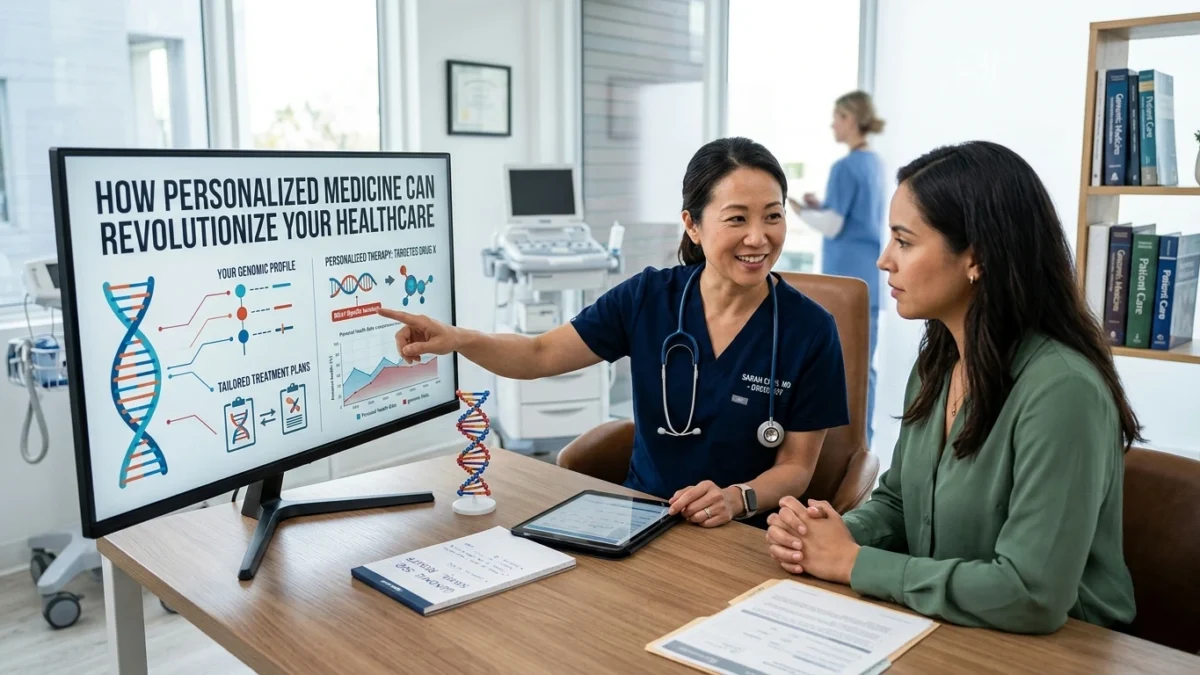
How Personalized Medicine Can Revolutionize Your Healthcare

Imagine a world where your healthcare is as unique as you are. Personalized medicine is not a distant dream but the exciting frontier. No more one-size-fits-all treatments. No more generic prescriptions for all patients. Regardless of their needs, today’s science and technology have advanced to make it possible to provide medical care according to each person’s genetic makeup, lifestyle, and preference.
This is the way that personalized medicine is changing the delivery of healthcare and the approach to health and wellness. Better chances for more effective treatments that will lead to better results with less side effects. What is the real meaning of personalized medicine? Find out in our journey of healthcare. Welcome to a future of treatments specifically made for you!
What is Personalized Medicine?
Innovative therapies are defined as a departure from the traditional one-size-fits-all model and the incorporation of individual and unique biological attributes. The innovative field of personalized medicine leverages genetic, environmental, and lifestyle factors to develop targeted therapies. By understanding these variables, healthcare providers can deliver more effective interventions.
At the core of personalized medicine is its focus on precision. The new way will work because, instead of guessing which treatment might work best for you based on average responses, it seeks out your specific needs.
With advanced data analytics and technology, the doctor can now make a well-informed decision that fits you specifically. This shift, therefore, not only enhances outcomes but also minimizes the potential side effects associated with generalized treatments.
Benefits of Tailored Treatments
Tailored treatments open up a new horizon in healthcare, better addressing individual needs than one can do through traditional methods. They take into account factors ranging from genetic makeup to lifestyle so that the most appropriate therapy is administered to each patient.
One significant benefit is increased efficacy. With personalized medicine, therapies are designed to target specific health issues rather than adopting a one-size-fits-all approach; this, in turn, leads to better outcomes and fewer side effects.
Tailored treatments also enhance patient engagement. When people can understand the plan of care that is specifically for them and it works positively, then they will follow such a plan, having ownership of their health journey.
These treatments can also bring about long-term cost savings by cutting trial and error prescribing and hospital readmissions because treatment plans don’t work. Personalized approaches improve lives and optimize healthcare resources.
Advanced Tech at the Core of Personalized Medicine
Advanced technology is at the core of personalized medicine. It allows healthcare providers to create treatment plans based on individual patient profiles.
Artificial intelligence makes it easier to analyze huge datasets. AI algorithms can find patterns and make predictions on how different patients will respond to a given treatment.
Genomic sequencing has changed our understanding of diseases from the molecular level. DNA decoding assists in the determination of genetic mutations that create conditions, so doctors can take targeted interventions.
Wearable devices also make a big contribution to personalization. These devices track health metrics continuously and in real time, shedding light on factors related to lifestyle that can influence the success of treatments.
Machine learning helps improve the process by improving predictions continually as new data becomes available. This dynamic approach ensures that treatments move together with advancements in medical knowledge and patient feedback.
Through these technologies, personalized medicine is fast becoming quite a reality and not just a far-off dream for most patients today.
How Genetic Testing Fits In
Genetic testing makes up the foundation of personalized medicine. It allows for the possibility of determining individual risks to health and response to treatment.
Healthcare providers and professionals can use DNA data to identify genetic markers related to various diseases. The information can then be used to develop more specific treatments that are tailored to the individual patient.
For example, some cancer treatments work better if specific gene mutations are present in tumors. In the hands of attentive oncologists, these details can translate into better treatment response rates and fewer side effects.
Genetic tests can also show the way for prevention. If a person has the genes that raise their vulnerability to certain ailments, preventive measures can be initiated in the initial stages.
Genetic information has also been used to guide and inform medical treatment, thus increasing the precision of care. It’s not just about the treatment of illness; it’s about adapting treatments to who you are at a molecular level.
Healthcare Game Changers
Personalized medicine has been changing lives all over the world. One particularly successful instance occurred when a young woman was diagnosed with an aggressive form of breast cancer. Genetic testing revealed a specific mutation, and doctors were able to use targeted therapies to customize and greatly improve her prognosis.
In one case, a man who had chronic migraines was put on a personalized regimen based on his genetic variations. By determining how he metabolized drugs, doctors were able to find the best treatments for him.
Children with rare genetic diseases are also making great progress. For example, gene therapy has restored normal function in patients suffering from spinal muscular atrophy. These stories don’t just showcase progress, they also showcase hope and resilience.
More people tell their stories; it seems obvious that personalized medicine can really make healthy outcomes better among many different kinds of people. Each success story makes it easier for the next person to find a good answer in their own health care.
Challenges for Personalized Medicine
Personalized medicine can do great things but it has some big problems too. One of the biggest problems is that not many people can have a test to look at their genes. Most people don’t have enough money or a way to get these kinds of services.
Concerns for data privacy also stand large. Patients are worried about the use and sharing of their genetic information. This skepticism can hinder their participation in studies and trials that are so important for progress.
There is also a need for comprehensive education among healthcare providers. Many practitioners may not fully understand personalized approaches and, as a result, impact patient care options.
Challenges also lie in integrating these systems into the existing healthcare setup. Most often, the clash between the traditional method and the new technology creates friction in the process of treatment.
Regulatory frameworks need to evolve at the same pace as the innovation in personalized medicine. Without proper guidelines, it would be a challenge for patients as well as providers to make their way through this rapidly changing landscape.
Future Trends in Personalized Healthcare
The future of personalized medicine is very bright. With the increasing role of artificial intelligence in healthcare as a technology enabler, more and more data can be analyzed to make quick and more accurate recommendations for treatments.
Wearable tech is pretty mainstream these days. And it streams health metrics in real time, to both patients and providers. Instant data like this makes it easy to personalize treatments at the individual level.
Telemedicine is gaining ground as a key element of personalized care. Patients can be referred to specialists regardless of location, thus enabling the customization of treatment plans based on specific health needs.
Another interesting development is in the field of pharmacogenomics. Soon, we will have drugs that work much better, with far fewer side effects because we will understand how our genes influence the way drugs are metabolized.
Microbiome research is another area that will further shed light on personalized healthcare and pave the way for customized nutritional and lifestyle interventions based on the dynamics of gut health.
Embracing Your Healthcare Revolution
The movement of healthcare to personalized medicine is not simply a fad but one that transforms. As more people learn of their genetic make-up, the treatments designed specifically for them increase. This guarantees that patients will be treated with care designed for them, not some general solution.
This is joining the new order of health advocacy and taking an active role in your medical care. Technology has made it possible to access genetic testing, so you can make an informed decision on treatment options.
Think about talking with your doctor to develop a set of treatments that can be more personalized to you based on your genetics or lifestyle. It gives you the power to take control not just of how you feel today but also of what’s going to come next.
In an age where medicine becomes personalized in standard practice, staying informed will be of utmost importance. Engage with professionals who can understand these developments and seek resources to guide you through this exciting landscape.
Your healthcare journey is yours alone, so take advantage of tailoring it to what works best for you. This leads to better results and a higher quality of life than ever before.